Taj Mahal: India's Eternal Symbol of Love
Built by Emperor Shah Jahan to honour his queen Mumtaz Mahal, the Taj Mahal is a 17th-century masterpiece of Mughal art and undying devotion.
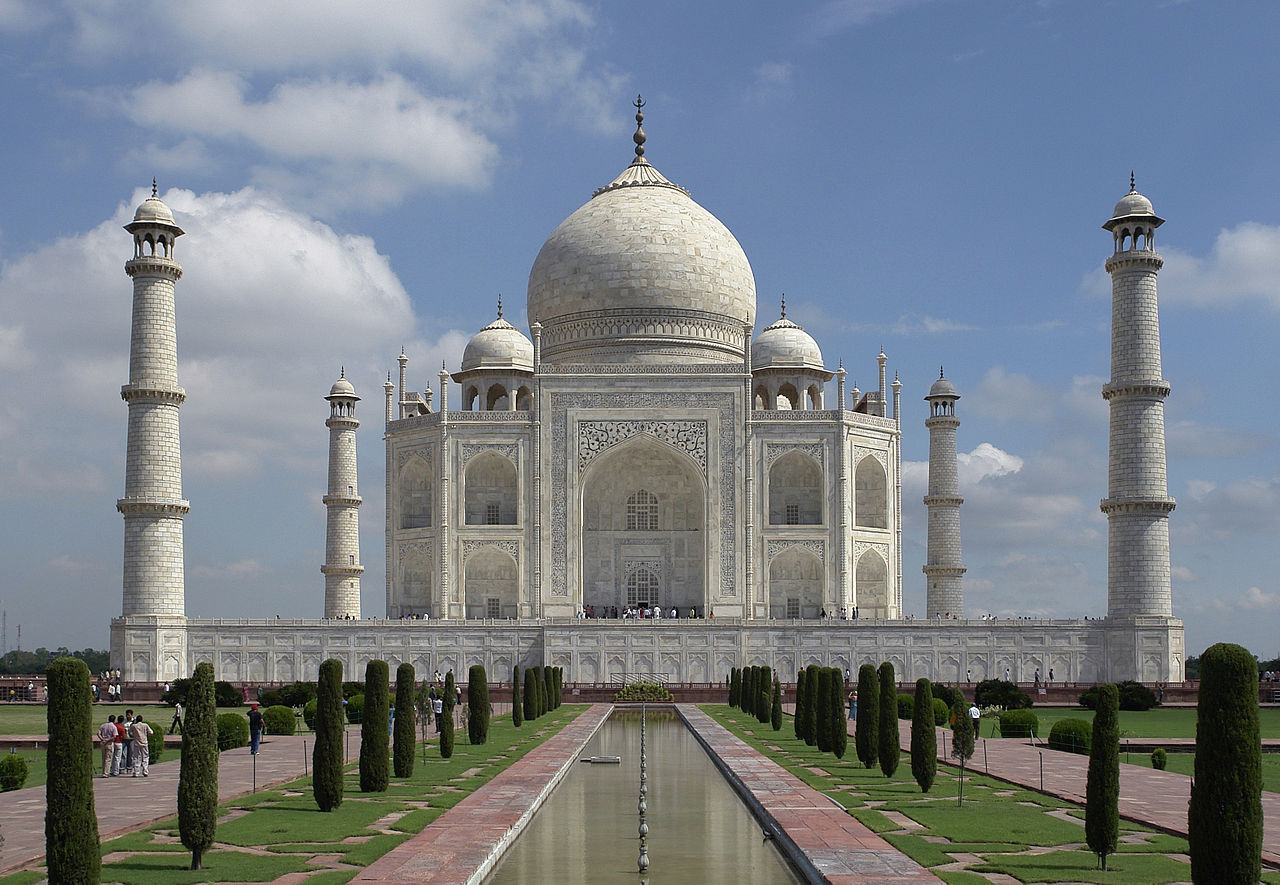
Imagine standing at the end of a long garden path as the sun rises over Agra. The sky turns pale orange. And there it is. The Taj Mahal. Glowing as if it is lit from inside.
No other building in the world stops people in their tracks quite like this one. It is not just the size. It is not just the white marble. It is the feeling it gives you the moment you first see it.
The Taj Mahal sits on the banks of the Yamuna River in Agra, in the northern Indian state of Uttar Pradesh. Every year, more than six million people travel from every corner of the world to stand in this garden. And almost every single one of them falls quiet.
This is not just India's most famous landmark. It is one of the most loved buildings on the face of the earth.
The Story Behind the Stone
Every great monument has a story. The Taj Mahal has one of the greatest love stories ever told.
In 1607, a young Mughal prince named Khurram met a woman at a royal bazaar in Agra. Her name was Arjumand Banu Begum. He was immediately captivated. They married in 1612, and from that day forward they were inseparable.
The prince went on to become Emperor Shah Jahan, meaning King of the World. He renamed his beloved queen Mumtaz Mahal, which in Persian means Jewel of the Palace. She travelled everywhere with him. She advised him on affairs of state. She bore him fourteen children. She was, by every account, the centre of his world.
Then, in June 1631, Mumtaz Mahal died during childbirth in the town of Burhanpur. She was 38 years old.
The Emperor was broken. Mughal court records describe Shah Jahan refusing to eat properly for weeks. He stopped listening to music. He avoided the ceremonies that emperors are expected to attend. When he finally appeared in public again, his hair had turned white.
He made a promise. He would build her the most beautiful resting place the world had ever seen.
Construction began in 1632. Over the next 21 years, around 20,000 craftsmen and workers came from across India, Persia, Central Asia, and the Ottoman Empire to build it. The complex was finally completed in 1653.
Shah Jahan never got to enjoy the Taj Mahal as a free man. In 1658, his own son Aurangzeb overthrew him and locked him in the Agra Fort. For the last eight years of his life, the old emperor is said to have spent his days looking out of a window at the Taj Mahal across the river. He died in 1666 and was buried next to Mumtaz Mahal inside.
What Makes It So Beautiful
Experts in art and architecture have spent centuries trying to explain what makes the Taj Mahal so extraordinary. The short answer is that everything about it works together.
The Marble That Changes Colour
The entire mausoleum is built from white marble brought from Makrana in Rajasthan, a town about 400 kilometres from Agra that has been famous for its quarries for thousands of years.
This marble does something remarkable. It changes colour throughout the day. In the early morning it glows soft pink. At noon it turns a pure, bright white. In the evening it shifts to warm gold. And by moonlight it looks almost silver.
No photograph fully captures this. You have to see it to understand.
The Inlay Work
Look closely at the surface of the Taj Mahal and you will see thousands of tiny flowers, vines, and geometric patterns set into the marble. This is called pietra dura, an ancient technique in which semi-precious stones are cut into precise shapes and fixed into stone surfaces.
More than 28 different types of stone were used, including lapis lazuli from Afghanistan, turquoise from Tibet, jade from China, and carnelian from Arabia. Some historians believe the finest individual panels took single artisans years to complete.
The Calligraphy
Running along the arches and walls of the Taj Mahal are verses from the Holy Quran, written by the Persian master calligrapher Amanat Khan. He is the only craftsman whose name appears anywhere on the entire complex.
The inscriptions are slightly larger at the top than at the bottom. This was a deliberate choice. Viewed from the ground, they appear perfectly even.
The Garden
The Taj Mahal does not stand alone. It sits within a formal garden that follows an ancient Persian design called the char bagh, meaning four gardens. The space is divided into four equal sections by water channels and stone pathways.
At the centre of the garden is a long raised pool called the Hauz-i-Kausar, the pool of abundance. When conditions are right, the entire Taj Mahal reflects perfectly in the water. It is the image that appears on most postcards and most phone screens around the world.
Cypress trees line every path. In Persian tradition they represent eternity. The flowering plants and fruit trees around them represent paradise.
Key Facts
Key Facts
Feature | Detail |
|---|---|
Location | Agra, Uttar Pradesh, India |
Built by | Emperor Shah Jahan |
Built for | Mumtaz Mahal |
Construction dates | 1632 to 1653 |
Architectural style | Mughal (Persian, Indian and Islamic) |
Main material | White marble from Makrana, Rajasthan |
Height | 73 metres (240 feet) |
Total site area | 42 acres (17 hectares) |
Number of workers | Around 20,000 |
Chief architect | Ustad Ahmad Lahauri |
UNESCO status | World Heritage Site since 1983 |
What Is Inside
Beneath the great dome is a chamber that surprises most visitors. It is quiet and cool. The light changes as it passes through the carved marble screens that surround the room.
At the centre of the chamber are two cenotaphs, which are decorative tombs placed above the actual burial site. One belongs to Mumtaz Mahal. The other belongs to Shah Jahan. The real graves are in a sealed crypt directly below, at ground level. This follows Islamic tradition, which holds that a true burial should be simple and close to the earth.
Mumtaz Mahal's cenotaph sits exactly at the centre of the room. This is where she was always meant to rest. Shah Jahan's cenotaph is placed slightly to her left. It is the only thing in the entire Taj Mahal that is not perfectly symmetrical. He was added after his death, long after the building was designed for her alone.
For many visitors, this small detail is the most moving thing about the whole monument.

The Taj Mahal complex showing the char bagh garden and central reflecting pool. — Wikimedia Commons / Public Domain
Why UNESCO Stepped In
In 1983, the UNESCO World Heritage Committee added the Taj Mahal to its World Heritage List. UNESCO described it as the jewel of Muslim art in India and one of the universally admired masterpieces of the world's heritage.
Being recognised as special has not protected it from damage, though. Air pollution from nearby factories and heavy traffic has caused the white marble to yellow in places. Acid rain eats steadily into the surface. Millions of footsteps wear down the paths and platforms every year.
The Archaeological Survey of India has responded with a treatment called mud packing, where a special paste is applied to the marble, left to dry, and then carefully removed, taking pollution and staining with it. The process is slow and has to be repeated regularly.
India's Supreme Court has also stepped in, restricting industrial activity in the zone surrounding the Taj Mahal and banning heavy vehicles from its immediate area. Keeping this building beautiful requires real effort from every generation that inherits it.
When to Go and What to Expect
The best time to visit is between October and March. The weather in Agra is cool and clear. The light in the early morning hours is extraordinary.
Sunrise is the moment most people remember for the rest of their lives. The marble turns pink and gold before your eyes. The reflecting pool catches the whole building in its surface. If you can only visit at one time of day, make it sunrise.
The official tourism portal for India also offers full moon night visits on five nights surrounding each full moon every month. Tickets must be booked in advance through the ASI. The Taj Mahal at midnight, under a full moon, is one of those experiences that people struggle to put into words afterwards.
Visitor Information
Visitor Information
Category | Details |
|---|---|
Opening hours | Sunrise to sunset, every day except Friday |
Full moon visits | 8:30 PM to 12:30 AM, five nights per full moon (advance booking required) |
Entry fee (foreign visitors) | Rs 1,100 per person (around US $13) |
Entry fee (Indian visitors) | Rs 50 per person |
Best time to visit | October to March |
Nearest airport | Agra Airport or Delhi (230 km, about 3 hours by train) |
Photography | Allowed everywhere except certain interior spots. No tripods or selfie sticks |
Dress code | Modest dress is expected. Cover shoulders and knees |
Banned items | Food, alcohol, tobacco, large bags, drones |
Best photo spot | Central garden path, Diana's Bench, or Mehtab Bagh across the river |
Why It Still Matters
In 2007, more than 100 million people around the world voted the Taj Mahal one of the New Seven Wonders of the World. It was one of the clearest results in the entire poll.
The Taj Mahal appears on Indian currency, on postage stamps, and in the imaginations of people who have never set foot in India. It has been painted by masters, photographed billions of times, and copied in places as far apart as Bangladesh and the United States. None of the copies come close.
The Indian poet Rabindranath Tagore once described it as a teardrop on the cheek of time. Smithsonian Magazine called it simply the most beautiful building in the world.
What makes those descriptions ring true is not the building alone. It is the story behind it. The Taj Mahal is what one person built when they could not accept that someone they loved was gone. It is the physical shape of grief turned into something the whole world can share.
A Final Thought
The Taj Mahal belongs to India. But it also belongs to everyone.
It belongs to everyone who has ever loved someone deeply. It belongs to everyone who has ever lost someone and not known what to do with that loss. It belongs to everyone who has looked at something made by human hands and felt the quiet comfort of knowing that people have always been capable of extraordinary things, even in the hardest of times.
Go and see it if you can. Stand in front of it at sunrise. Stay quiet for a moment. Let it do what it has been doing to every visitor who has ever stood in that garden for nearly 400 years.
It will move you. It always does.
