Cold Blob in Atlantic: Earth's Scariest Climate Signal
The cold blob in the Atlantic has been cooling for over a century. New research confirms it's the clearest sign yet that a critical ocean current is approaching a dangerous tipping point.

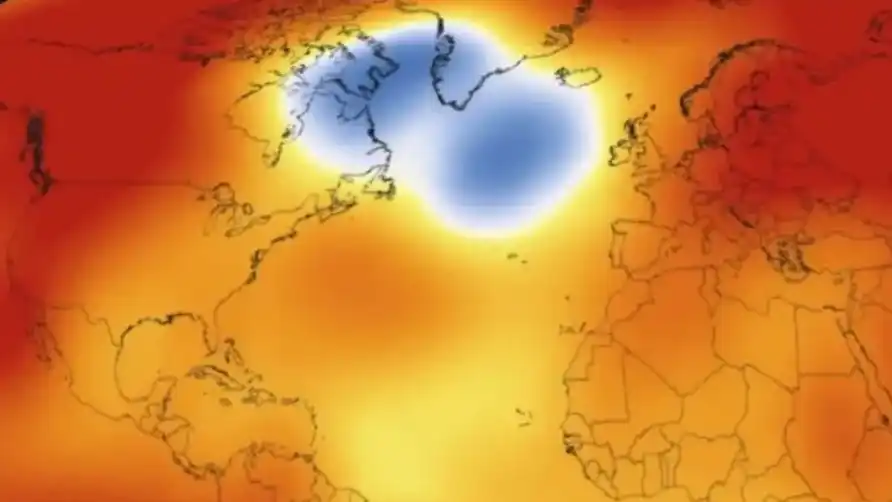
There is a patch of the Atlantic Ocean south of Greenland that has been cooling for over 100 years, quietly defying a warming planet. Scientists have a name for it. They have measurements stretching back decades. And now, after years of divided opinion, a landmark new study says they finally know what is driving it.
The answer is deeply unsettling.
The Cold Blob in the Atlantic Has a Cause and It Points to Crisis
A study published in late May in Geophysical Research Letters led by climate physicist Stefan Rahmstorf at Germany's Potsdam Institute for Climate Impact Research used satellite records, ocean buoy data, ship measurements, and heat content figures going back to 1955 to examine what is behind this mysterious cooling zone.
Researchers had long been split on the cold blob in the Atlantic ocean: either ocean currents are delivering less warm water into the area, or the ocean surface is simply losing more heat to the atmosphere. This new analysis checked both options against direct observational data rather than relying solely on models.
The verdict is clear on causation. Surface temperatures in the cold blob region have been declining but the cause is not increased heat loss through the ocean surface. The data show surface heat flux in the region has actually decreased over the study period. The cold extends roughly 1,000 meters deep, driven by changes in how much warm water the ocean is transporting into the region.
That points directly at a weakening of the Atlantic Meridional Overturning Circulation, or AMOC one of the most consequential climate systems on the planet.
What the AMOC Actually Does
Picture a massive conveyor belt running through the Atlantic. Warm surface water moves north from the tropics, releases heat into the atmosphere above northern Europe and the North Atlantic, then cools, densifies, and sinks deep before flowing back south. That is the AMOC.
This system is the primary reason northern Europe is temperate despite sitting at latitudes comparable to much colder parts of Canada and Russia. It shapes monsoon systems in Africa and Asia. It affects sea levels along the US East Coast. It regulates the distribution of marine ecosystems and fisheries across the entire North Atlantic Basin.
According to Live Science, the cold blob region sits at the exact northern tip of this circulation system the precise location where the AMOC delivers most of its heat. When the circulation weakens and less warm water travels north, temperatures here fall. That is what the data shows has been happening since the 19th century.
The center of the cold blob has cooled by close to 1°C (1.8°F) since 1900, according to researchers at ScienceAlert a seemingly modest figure that, in ocean terms, represents a vast amount of missing heat.
The Numbers That Should Stop You in Your Tracks
Multiple independent lines of evidence, cited in the new Geophysical Research Letters study, point toward the same conclusion about the AMOC's decline.
The mechanism is straightforward. The AMOC runs on a precise balance of temperature and salinity. Freshwater from melting glaciers is less dense than saltwater, so as it pours into the North Atlantic it interferes with the sinking mechanism that keeps the entire circulation moving. More melt means more disruption.
A Tipping Point Closer Than Anyone Wanted to Admit
For most of his 35-year career researching the AMOC, Stefan Rahmstorf estimated roughly a 5 percent chance of its collapse. That number has changed. In a May 2026 piece for Yale Environment 360, he put it closer to 50/50 and added that he would say the odds are now more likely than not.
That is a significant shift in how a leading scientist in this field is communicating risk to the public.
The new study is careful not to claim the tipping point is imminent. It is worth noting that the IPCC Sixth Assessment Report assessed an abrupt AMOC collapse before 2100 as "very unlikely," with medium confidence a finding supported by a 2025 Nature study from the Met Office and University of Exeter, which found the AMOC would weaken but is unlikely to fully collapse within the next 75 years. These findings reflect important uncertainty in timing that science has not resolved.
At the same time, the 2026 GRL paper notes that standard CMIP6 climate model simulations suggest the AMOC tipping point could be crossed around mid-century in a substantial subset of warming scenarios. Once that threshold is crossed in these model scenarios, the trajectory toward full weakening becomes locked in even if the actual shutdown unfolds over decades.
The study's authors state plainly in the published paper that the risk requires urgent attention from policymakers. Governments are starting to move. In October 2024, more than 40 climate researchers signed an open letter to Nordic ministers about the severity of the AMOC threat. By November 2025, Iceland went further formally designating a potential AMOC shutdown as a national security threat. That is a government treating a climate finding with the same weight as a military risk assessment.
What a Collapse Would Actually Mean
An AMOC failure would not just affect Europe's winters. The consequences would ripple across every continent, based on projections detailed by researchers via Yale Environment 360.
The temperature gradient between northern and southern Europe would widen by roughly 4°C, intensifying storm systems across the continent. Agricultural regions would face severe disruption. African and Asian monsoons, which bring rainfall to billions of people, would weaken. Sea levels along the US East Coast would rise beyond what global ocean warming alone predicts. Climate models also project that the Southern Ocean could release stored deep carbon into the atmosphere, further feeding the warming that drives the problem though researchers note this remains a modeled projection rather than a confirmed outcome.
The debate among researchers is largely about timing and degree not whether these outcomes are physically plausible.
The Measurement Gap Nobody Is Addressing
Here is a detail that deserves more attention than it gets. The AMOC monitoring record spans only about 20 years. For a circulation system that operates on century and millennial timescales, that is an extraordinarily thin dataset.
Scientists supplement it with proxy indicators: ocean salinity gradients, sediment cores, coral records, ice cores from Greenland. These broadly support evidence of AMOC-linked change over recent decades, though the IPCC has noted that the short observational record limits how confidently scientists can quantify the exact magnitude of weakening or fully attribute it to human forcing.
Live Science reported that the Trump administration was planning to remove 900 deep-sea monitoring instruments from the Atlantic and Pacific Oceans instruments that would have tracked precisely the kind of AMOC changes scientists are now raising alarms about.
It is also worth noting the science is not without internal debate. A 2021 study using some of the same datasets attributed a significant portion of the cold blob's cooling to wind pattern strengthening rather than AMOC changes. David Thornalley of University College London, who was not part of the new research, has called the study valuable but says it is unlikely to be the final word on the matter.
The difference now is the accumulation of evidence across different methodologies, with a growing share pointing toward reduced ocean heat transport as the primary driver.
This Is Not a Warning From the Future
The cold blob in the Atlantic exists right now. It is not a projected output or a speculative scenario. It is a measurable, observable feature of the ocean that has been getting colder for more than a century. What the latest research settles is the most likely cause and what that cause implies about where the AMOC is headed.
The precise timeline of collapse remains genuinely uncertain, with credible scientific opinion spanning a wide range. What is not uncertain is that the system is under documented, human-driven stress, and that a growing body of research places the risk higher than it was estimated even a decade ago.
Whether the global response matches that scale of risk is a different question entirely.
- cold blob in atlantic
- AMOC
- Atlantic Ocean
- climate tipping point
- ocean currents
- Gulf Stream