Strawberry Moon Full Moon Tonight Peaks at 7:56 p.m. EDT
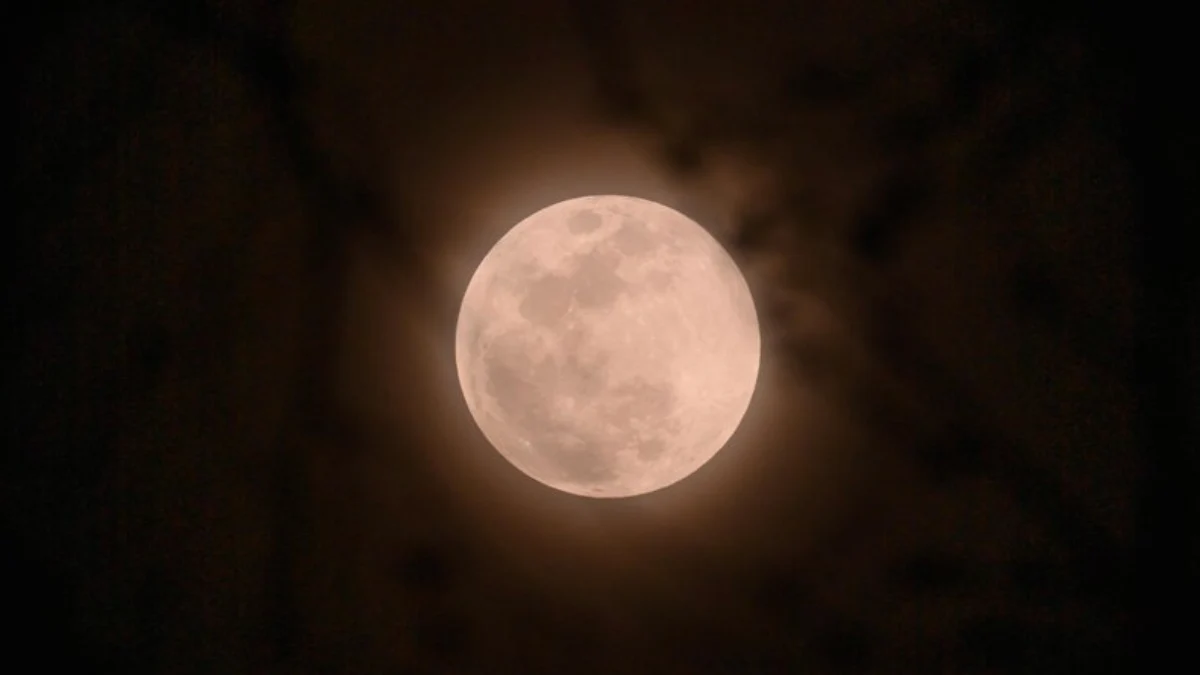
The Strawberry Moon full moon tonight peaks at 7:56 p.m. EDT on June 29, a micromoon with a low northern arc that may glow amber at moonrise tonight.

The June 2026 full Moon, known as the Strawberry Moon, reaches exact full phase at 23:56 UTC on June 29, 2026, which is 7:56 p.m. EDT in New York and 5:26 a.m. IST on June 30 in India, according to the U.S. Naval Observatory's official phase service. A small number of publishers list the peak one minute later, at 23:57 UTC, a rounding difference between calculation models that reflects no real disagreement about the date, according to Time and Date distance data.
Despite what the name might suggest, the Moon will not turn strawberry-red. The name is seasonal, not a color forecast. And despite what some other outlets have reported, this is not a supermoon, it is a micromoon, occurring near the farthest point of the Moon's orbit. What it will do, under clear skies, is rise low and glow amber.
When to Look Up and Where
The precise full-phase moment is a single global instant, 23:56 UTC, but the best visual opportunity for most people is around local moonrise, when the Moon hovers near the horizon and atmospheric scattering turns it orange or amber.
Exact moonrise varies by location and is best checked through a local calculator at Timeanddate's moonrise tool. In New Delhi, for example, moonrise on June 29 is around 7:11 p.m. IST, several hours before the global full-phase instant arrives early on June 30. In New York, the Moon reaches exact full phase at 7:56 p.m. EDT, close to local moonrise.
For observers in the United Kingdom, full phase crosses midnight: Royal Museums Greenwich places it at about 12:56 a.m. BST on June 30, consistent with the 23:56 UTC instant converted to British Summer Time (UTC+1).
The disk appears essentially full on the evenings surrounding the exact phase, June 28, 29, and 30 all look close to identical to casual observers, according to Timeanddate's June Moon guide.
Why It Glows Amber but Will Not Turn Red
When the Moon sits close to the horizon, its light travels through a much longer stretch of atmosphere to reach your eyes. That extra air scatters shorter blue wavelengths away, leaving yellow, orange, and amber tones, the same physics that makes sunsets red. Local smoke, dust, or haze intensifies the effect. NASA explains the phenomenon in detail.
A deep red or blood-Moon appearance requires a lunar eclipse, when Earth's shadow falls across the Moon. There is no lunar eclipse on June 29, 2026. The U.S. Naval Observatory's eclipse calendar lists the next lunar eclipse as a partial event on August 28, 2026, a deep partial at 96.2% umbral coverage, visible across North and South America and parts of Europe and Africa.
The Lowest Full Moon of the Northern Year
The Strawberry Moon follows the summer solstice, which fell on June 21 at 08:24 UTC this year, per the U.S. Naval Observatory's seasonal data, by just eight days. That timing matters for the view.
The full Moon always sits roughly opposite the Sun in the sky. In late June, the Sun is at its highest and most northerly point of the year, so the full Moon is correspondingly low and southerly. For Northern Hemisphere observers, the Strawberry Moon traces a shorter, lower arc across the sky than any other full Moon of the year, as Space.com explains in its hemispheric breakdown.
Southern Hemisphere observers see the opposite. June's full Moon rises high for them, following a long winter arc, the same geometric logic flipped by the season.
A Micromoon That Can Still Look Large
This Strawberry Moon is a micromoon. Full phase falls near lunar apogee, the farthest point of the Moon's elliptical orbit from Earth, making the lunar disk roughly 6 to 7 percent smaller in angular size than an average full Moon, according to Time and Date distance data.
NASA's supermoon list does not include June in its 2026 supermoon dates. Those fall in late November and December. Any article describing the June 2026 Strawberry Moon as a supermoon is incorrect.
The shrinkage is not something most people notice without direct comparison. What observers do notice is the Moon illusion, the perceptual trick in which the Moon appears markedly larger when it sits near the horizon and can be referenced against trees, buildings, or hilltops. The enlargement is not physical, NASA notes, but the sense of scale is striking regardless. A micromoon near the horizon through the Moon illusion still looks bigger than a supermoon high overhead.
Where the Name Comes From
The "Strawberry Moon" label is cultural, not astronomical. It comes from seasonal naming traditions tied to the natural calendar, not to the Moon's appearance.
Documented Ojibwe sources provide some of the clearest direct evidence. The Great Lakes Indian Fish and Wildlife Commission, an intertribal agency serving Ojibwe member tribes, translates the June moon period as Ode'imini-Giizis: "Time for Picking Strawberry Moon," marking early-ripening wild strawberries. Oneida Nation publications document their own Strawberry Moon name for June and describe the strawberry's ceremonial and cultural significance within their community. The National Park Service's Ojibwemowin resource also documents Ode'imini-giizis as a June moon name tied to the wild strawberry harvest.
Attributing one identical label to every Indigenous nation is an oversimplification. Different nations maintained distinct languages and seasonal calendars. What the verified evidence supports is that the June full Moon carried strawberry associations in at least some Ojibwe and Oneida traditions.
The name also appears under other variants. The Royal Museums Greenwich full Moon calendar lists Rose Moon and Hot Moon as alternative June names, each from different cultural traditions. The Old Farmer's Almanac, which currently uses and explains the Strawberry Moon label, has contributed to its mainstream popularity, though the exact history of how it entered widespread American usage is harder to trace than the Indigenous origins themselves.
Viewing Tips
A low Moon rises and sets near the eastern and western horizons respectively, making the window around moonrise the most atmospheric moment to watch. Find an open view toward the east, a hilltop, a beach, or a rooftop with a clear horizon. High-rise obstructions and city light pollution reduce the effect but do not eliminate the amber coloring.
Cloud cover is the only true obstacle, and no global forecast applies. Check local conditions from an official meteorological service on the evening of June 29.
No telescope or binoculars are required. The Moon is one of the few objects bright enough to reward naked-eye observation, and the amber horizon coloring is most pronounced in the minutes right after moonrise before the Moon climbs higher and whitens again.
- strawberry moon full moon tonight
- strawberry moon 2026
- full moon June 2026
- micromoon
- June solstice moon