Ashura 2026: Meaning, Date, and How Muslims Observe It
Ashura is the 10th of Muharram, June 25 or 26 in 2026 depending on location. Here's what it means, who fasts, and why Sunni and Shia observances differ.

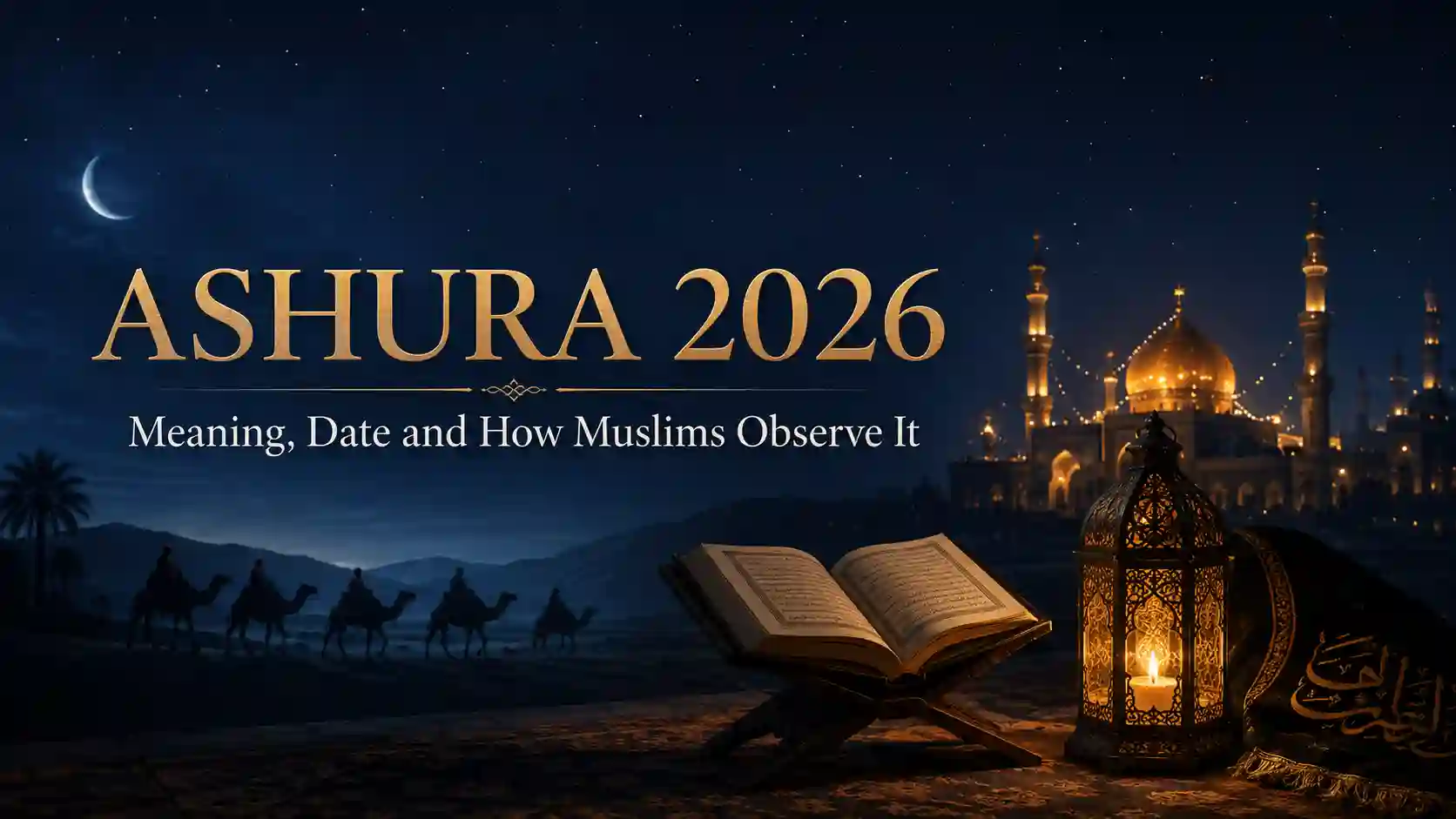
Ashura, observed on the 10th day of Muharram, the first month of the Islamic lunar calendar, fell on June 25 in Saudi Arabia and many other countries in 2026, while India's central government calendar listed the day as June 26, a routine one-day difference caused by local moon-sighting rules.
What Ashura Means
The name Ashura is conventionally linked to the Arabic word for ten, referring to the date on which it falls each year. Merriam-Webster records this etymology, while specialist scholarship in the Encyclopaedia Iranica notes that the word's deeper history involves cognate usage across Semitic languages. For a general reader, the simplest accurate description holds: Ashura is the tenth.
Muharram is one of four months designated as sacred in Qur'an 9:36, and the day carries distinct significance for Sunni and Shia Muslims, not always the same significance, and not always the same customs.
Ashura 2026 Date: Why It Differs by Country
Because the Islamic calendar follows the lunar cycle, Ashura's Gregorian date shifts by roughly ten or eleven days each year. Within a single year, the date can also fall one day apart between countries, depending on when a local religious authority confirms the new crescent moon.
In 2026, the Saudi Press Agency placed the first of Muharram on June 16, putting Ashura on Thursday, June 25. The Government of India's official 2026 holiday order listed the holiday on Friday, June 26, with a note permitting moon-sighting adjustments. Pakistan's final public-holiday notifications, issued after crescent confirmation, identified June 26 as 10 Muharram, though the advance Cabinet Division calendar issued earlier in the year had anticipated different provisional dates pending moon sighting.
Neither date is incorrect. They reflect legitimate differences in when communities confirmed the start of Muharram.
When Does Ashura Start and End?
In the Islamic calendar, a date begins at sunset and ends at the following sunset. Ashura as a religious date therefore runs from sunset on the ninth of Muharram to sunset on the tenth.
The voluntary fast, however, does not begin at sunset, it begins at true dawn and ends at sunset. Qur'an 2:187 establishes that the fasting interval in Islamic practice runs from the first light of dawn until nightfall. Under the June 25 dating, observing Muslims who fasted would have done so from dawn to sunset that Thursday.
Sunni Observance: The Fast and Its Origins
For Sunni Muslims, the defining significance of Ashura is a voluntary fast rooted in canonical hadith. According to Sahih al-Bukhari 3397 and Sahih Muslim 1130c, the Prophet Muhammad arrived in Medina after the migration and found people fasting on this day in gratitude for God's deliverance of Moses and the Children of Israel from Pharaoh. He was told the Jewish community observed it for that reason. Muhammad then said that Muslims had a stronger claim to Moses, and fasted the day himself.
The fast is voluntary. A sound hadith, Sahih Muslim 1162b, records that Muhammad described fasting Ashura as expiating sins of the preceding year. Mainstream scholars explain this as referring to minor sins, major sins require sincere repentance, as established in Sahih Muslim 233c.
Quraysh, the tribe of Mecca, observed a fast on this day before Islam. That pre-Islamic practice is confirmed in Sahih al-Bukhari 2002. After Ramadan fasting became obligatory, Ashura fasting remained a recommended but non-compulsory act.
How Many Days Should You Fast?
The question of whether to fast one, two, or three days around Ashura reflects a genuine variation in scholarly guidance.
Sahih Muslim 1134a records that Muhammad intended to fast the ninth of Muharram, known as Tasu'a, in addition to the tenth, had he lived another year. This is the strongest canonical basis for the recommendation to pair the ninth with the tenth.
The Jordanian General Iftaa Department, an official Sunni legal authority, states that fasting only the tenth is permissible, fasting the ninth and tenth is preferable, and some juristic rankings include all three days, the ninth, tenth, and eleventh. The ninth-plus-tenth pairing holds the strongest explicit canonical basis.
Shia Observance: Karbala and Mourning
For Shia Muslims, Ashura is primarily a day of mourning. On October 10, 680, corresponding to 10 Muharram 61 AH, Husayn ibn Ali, the grandson of Prophet Muhammad, was killed along with his small group of companions at the Battle of Karbala in present-day Iraq, according to Encyclopaedia Britannica. He had refused to give his allegiance to Yazid I, the Umayyad caliph.
Karbala did not originate every division between Sunni and Shia Muslims, succession disputes had existed since the death of Muhammad, but the battle became a defining event in Shia history and a symbol of resistance against injustice that persists in Shia devotional culture today.
Contemporary Shia observances include mourning assemblies, elegies, processions, chest-beating (matam), food distribution, and in some communities, blood donation campaigns. The Associated Press documented large observances across Lebanon, Iran, and elsewhere on June 25, 2026.
Self-flagellation or bloodletting occurs in some communities but is not universal. Senior Shia authorities including Ayatollah Ali Khamenei and Ayatollah Ali al-Sistani have opposed or discouraged the practice. It is not representative of the broader commemoration.
Iran also maintains a centuries-old theatrical tradition called Ta'ziye, ritual dramatic performances re-enacting the Karbala story through poetry, music, and movement. UNESCO inscribed Ta'ziye on its Representative List of the Intangible Cultural Heritage of Humanity in 2010.
Is Ashura a Public Holiday?
The answer depends entirely on the country.
Ashura is a public holiday in some jurisdictions. India's central government lists it as a gazetted holiday for central-government offices. The Maharashtra state authority MMRDA also listed it as a public holiday on June 26. The Associated Press reported it as a public holiday in Iran during the 2026 observances.
It is not a U.S. federal holiday. The U.S. Office of Personnel Management's federal holiday list does not include it.
Whether private employers or local governments observe it elsewhere depends on each country's own labor law and holiday framework.
Claims That Are Not Well-Supported
Several widely circulated claims about Ashura are not established by strong canonical or historical sources and should not be taken as settled fact.
The assertions that Noah's ark landed on Ashura, that Adam's repentance occurred on Ashura, or that Jesus's birth or the Day of Judgment is tied to Ashura are not supported by the canonical Sunni hadith collections that authenticate the Moses narrative. These stories circulate in popular religious content but lack the same evidentiary grounding.
The claim that Ashura fasting forgives major sins automatically is also incorrect under mainstream scholarly teaching. The hadith attributes expiation of the preceding year to the fast, but scholars distinguish minor sins from major ones, which require repentance.
- what is ashura and why it is celebrated
- ashura meaning
- ashura 2026
- day of ashura
- muharram