Clive Davis, Who Found Whitney Houston, Dies at 94
Clive Davis, the music executive who discovered Whitney Houston and shaped six decades of pop, has died at 94 at his Manhattan home.

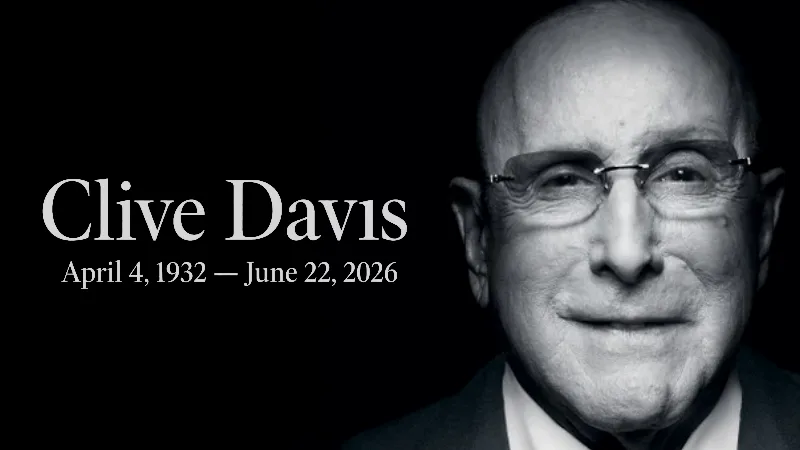
Clive Davis spent sixty years finding voices before the rest of the world knew to listen. On Monday, that ear for talent went quiet. Davis died at his Manhattan home at age 94, his family confirmed, closing out one of the longest and most consequential careers in modern music.
What Happened
His longtime representative, Aliza Rabinoff, said Davis "passed away peacefully from age-related illness surrounded by his family and loved ones." The family's own statement, shared publicly, called him "the iconic music legend whose vision, instincts and relentless pursuit of excellence shaped the soundtrack of countless lives." To them, though, he was simpler than that "Clive was Dad and Granddaddy, the steady presence at the center of our lives."
The death comes weeks after Davis was hospitalized in late May for an upper respiratory infection. He was released within days and was, according to a representative at the time, in good spirits and recovering at home. A specific cause of death has not been disclosed, and reports vary on further medical detail, what's confirmed is the age-related framing his team gave, nothing more specific than that.
The New York Times was first to report his death, with major outlets including CNN and Variety confirming it independently through his family and publicist.
Why It Matters
It's hard to overstate how much of the last sixty years of pop music ran through Clive Davis's office. He didn't just sign artists, he built three separate eras of the industry almost single-handedly.
The first came at Columbia Records, where Davis became president in 1967 at 35 and pushed the famously conservative label into rock and roll. He signed or championed Janis Joplin, Santana, Chicago, and a struggling singer-songwriter named Billy Joel, whose "Piano Man" became his breakthrough. He was fired from Columbia in 1973 after CBS accused him of misusing roughly $94,000 in corporate funds, a civil suit the label later settled out of court. Davis pleaded guilty to a single count of failing to pay taxes on job-related expenses and was fined $10,000, he maintained the broader allegations against him were unfair.
Davis didn't just survive it. He rebuilt.
In 1974, he founded Arista Records, naming it after the honor society at his Brooklyn high school. Arista became home to Aretha Franklin, the Grateful Dead, and Dionne Warwick, and, in 1983, to a 19-year-old singer Arista A&R man Gerry Griffith insisted Davis go see at a New York club, where she was singing backup for her own mother.
That singer was Whitney Houston.
The Whitney Houston Story
Davis later called Houston "the greatest contemporary singer of all time," and the partnership became the defining chapter of his career. Under his guidance, she scored seven consecutive number-one singles and sold more than 50 million records in the U.S. alone, according to figures cited in career retrospectives. When Houston died in 2012, hours before that year's Pre-Grammy Gala, the lavish industry party Davis had hosted since the 1970s, he chose to go ahead with the event, turning it into a tribute instead of canceling it.
That gala became as much a part of his legacy as any single signing. For roughly five decades, the night before the Grammys belonged to Clive Davis, and the guest list read like a history of the industry itself.
A Career By the Numbers
Milestone | Detail |
|---|---|
Columbia Records president | 1967–1973 |
Arista Records founded | 1974 |
J Records founded | 2000 |
Rock & Roll Hall of Fame induction | 2000, non-performer category |
Grammy honors | Four competitive Grammys as Album Producer, plus the separate Recording Academy Trustees Lifetime Achievement Award, some retrospectives round that up to "five Grammys" by counting the Trustees Award alongside the competitive wins |
Born | April 4, 1932, Brooklyn, NY |
Died | June 22, 2026, Manhattan, NY |
After leaving Arista in 2000, Davis founded J Records, which launched Alicia Keys, before later serving as Chief Creative Officer of Sony Music Entertainment. Even in his 90s, he kept hosting the Pre-Grammy Gala, he co-hosted the event this past January, just months before his death, with the Recording Academy honoring Republic Records founders Monte and Avery Lipman that night.
Beyond the Boardroom
Davis wasn't only a businessman. In 2002, he gave $5 million to his alma mater, NYU, establishing the Clive Davis Department of Recorded Music at the Tisch School of the Arts. He followed it with another $5 million gift in 2011 that expanded the department into the Clive Davis Institute of Recorded Music. A theater at the Grammy Museum in Los Angeles carries his name. In 2013, at 80, he published a memoir, "The Soundtrack of My Life," and used it to come out publicly as bisexual, a disclosure that made headlines well beyond the music press.
He is survived by his four children, Fred, Lauren, Mitch, and Doug, eight grandchildren, two great-grandchildren, and his partner, Greg Schriefer.
What Happens Next
No funeral or memorial details have been announced. Given Davis's stature, tributes from the artists he discovered and developed, many of whom owe entire chapters of their careers to a meeting in his office, are likely to keep arriving in the days ahead. Santana, one of his earliest signings, had already offered a glimpse of how he'll be remembered by those who knew him "If I were to draw a picture of Clive, it would be as a little child with a big heart and big ears."
That might be the simplest way to put it. He never stopped listening for the next one.
- Clive Davis
- Whitney Houston
- Arista Records
- music industry
- Grammy Awards
- obituary